



Engine Camshaft Degree Wheel
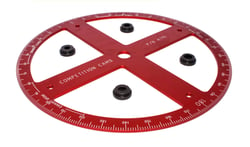






What Is a Camshaft Degree Wheel?
Degreeing a camshaft is one of the most important steps in building or rebuilding a performance engine. Engine camshaft degree wheels are specialized tools used to precisely verify that camshaft timing events — valve opening, valve closing, and lobe centerlines — are correctly synchronized with crankshaft position. Simply relying on the timing marks stamped into the cam or crank gears is rarely enough: stampings can be imprecise, loose tolerances can create slack in the valvetrain, and manufacturing variances can affect the accuracy of the original markings.
When a camshaft is properly "degreed," it means its position in the engine has been confirmed and synchronized with the crankshaft. Degreeing the cam is the only reliable way to determine if the rise and fall of the pistons correctly matches the opening and closing of the valves. Even a few degrees of misalignment can have a profound effect on engine operation and performance — costing horsepower, torque, and throttle response.
How Does a Degree Wheel Work?
The degree wheel is mounted to the front of the crankshaft, while a fixed pointer is attached to the engine block. With the number one piston set to Top Dead Center (TDC), the wheel's zero mark is aligned with the pointer. From there, a dial indicator measures camshaft lobe lift at precise crankshaft rotation increments, allowing the builder to calculate the intake and exhaust lobe centerlines and compare them against the cam manufacturer's specifications. If the installed centerline is off, the camshaft can be advanced or retarded using offset keys, bushings, or an adjustable timing set to bring timing into spec.
A key consideration when selecting a degree wheel is overall diameter. Larger wheels — 14 inches, 16 inches, or beyond — are easier to read and can deliver greater accuracy because their degree markings are more spread out. However, very large wheels may be difficult to use when the engine is still installed in the vehicle. Smaller 9- to 11-inch wheels are more compact and versatile for in-car applications. Many degree wheels are sold as complete kits that bundle the wheel with a dial indicator, TDC stop, pointer, and other accessories, making it easier to get started without hunting for individual components.
Top Brands for Engine Camshaft Degree Wheels
Proform Parts is a leader in the high-performance automotive aftermarket and offers a range of degree wheel solutions for a variety of applications. Their kits — including both universal and GM LS-specific versions — bundle a degree wheel, dial indicator, adjustable billet aluminum dial indicator mount, TDC locator, crankshaft turning socket, and a foam-padded carrying case, giving builders everything they need in one package. Proform also offers a professional 16-inch billet aluminum degree wheel for serious engine builders and tuners who want maximum readability.
COMP Cams has been a recognized authority in valvetrain technology since its establishment in 1976, and its camshaft degree wheels reflect that depth of expertise. Their degree wheels are designed to integrate onto virtually any harmonic balancer or be used with a COMP Cams crankshaft socket, and the brand's complete degree kits include a heads-off cam checking fixture, dial indicator, TDC stop, and all supporting hardware — even engine-specific kits for popular platforms like the GM LS. COMP Cams is widely trusted in circle track, drag racing, road racing, and street performance applications.
Mr. Gasket is a long-standing name in performance engine tools and accessories, and their camshaft degree wheels are a practical choice for enthusiasts who want straightforward, reliable tools for the job. Mr. Gasket offers both 7-inch and 11-inch diameter options, giving builders the flexibility to choose based on their workspace and engine configuration.
What Else Do You Need to Degree a Cam?
- Dial indicator with magnetic base or stand — for measuring lobe lift and piston position
- TDC piston stop — to accurately establish true top dead center before zeroing the wheel
- Degree wheel pointer — a fixed reference arm attached to the engine block
- Crankshaft turning socket — for smooth, controlled rotation of the crank during measurement
- Cam card — the specification sheet from your cam manufacturer listing the target lobe centerlines and duration figures
Whether you are building a mild street engine or a dedicated race motor, investing the time to properly degree your camshaft pays dividends in power, reliability, and long-term engine durability.