



Vacuum Gauge








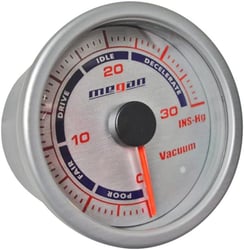




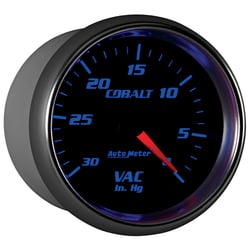

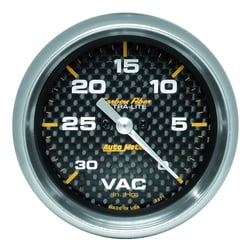


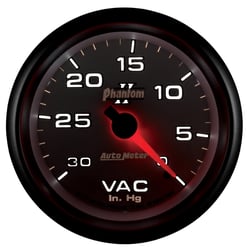


What Is a Vacuum Gauge and Why Does It Matter?
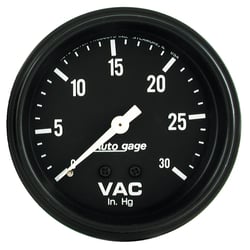
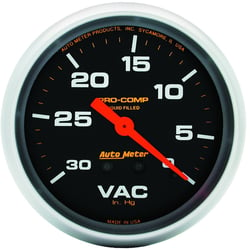
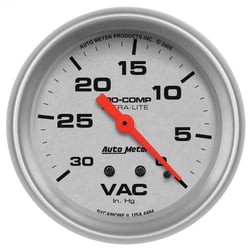
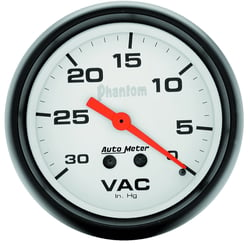
A vacuum gauge is one of the most informative instruments you can add to your vehicle's instrument panel. It measures the level of manifold vacuum — the negative pressure created inside an engine's intake manifold — and displays it in inches of mercury (in/Hg). That single reading can tell a skilled driver or tuner a surprising amount: engine health, throttle response, valve timing, carburetor calibration, and even overall fuel efficiency.
At idle, a healthy naturally aspirated engine typically produces steady manifold vacuum. Erratic, low, or fluctuating readings can signal worn piston rings, leaking intake gaskets, sticking valves, or ignition timing problems long before they show up as drivability issues. For that reason, a vacuum gauge has long been considered a staple diagnostic and tuning tool for both street and track applications.
Vacuum Gauges for Performance Tuning
Beyond diagnostics, vacuum gauges are widely used to optimize carburetor tuning. Holley, for example, has long recommended vacuum gauges as essential companions to their carburetors — knowing your manifold vacuum level is the correct way to select the right power valve for a Holley carburetor, directly affecting throttle response and fuel delivery at wide-open throttle. Many performance builders keep a vacuum gauge in their tuning kit as a standard practice.
On forced-induction engines — turbocharged or supercharged builds — a combined boost/vacuum gauge takes on an even more critical role. Vacuum gauges in this context track manifold vacuum under light throttle and transition to positive boost pressure readings when the turbo or supercharger spools up, giving drivers a complete picture of what their engine is doing at every moment.
Mechanical vs. Electric Vacuum Gauges
When shopping for a vacuum gauge, one of the first decisions is whether to go mechanical or electric. Mechanical gauges connect directly to the intake manifold via a small-diameter nylon or braided stainless line and require no electrical system connection whatsoever, making them universally compatible. Electric gauges use a MAP sensor and wiring harness to deliver readings to the dash, allowing for features like peak-recall memory, programmable warnings, and LED backlighting.
- Mechanical gauges — Simple, reliable, and budget-friendly. No power required; ideal for classic cars and straightforward builds.
- Electric/stepper motor gauges — Feature-rich with smooth needle movement, automatic atmospheric calibration, and integration with modern EFI systems.
- Combination boost/vacuum gauges — Dual-function instruments that read both vacuum (in/Hg) and positive boost pressure (PSI) on a single dial; a must for forced-induction applications.
Top Vacuum Gauge Brands
AutoMeter is the benchmark name in aftermarket gauges, and their vacuum gauge lineup reflects decades of motorsport development. AutoMeter's mechanical boost/vacuum gauges have found their way into more builds than any other, using a patented high-precision bourdon tube meter movement that delivers exceptional levels of accuracy and durability. For enthusiasts who prefer digital technology, AutoMeter's digital stepper motor gauges provide unparalleled response time and smooth needle movement, automatically calibrating on every startup to compensate for altitude, barometric pressure, and other atmospheric conditions.
Holley brings its deep carburetor and EFI expertise to the vacuum gauge segment. Holley's analog-style standalone gauges offer a simple yet modern way to monitor engine functions, with a slim mounting profile that requires very little dash space depth, and all gauges feature dimmable LED backlighting for visibility in any environment. Their EFI-specific vacuum/boost gauges integrate seamlessly into Holley EFI ecosystems via CAN-bus communication, making them an excellent choice for any Holley-equipped build.